Happy Plant
Ammara Azhar
3:05 pm - November 5, 2026
Share:
What Are Pitcher Plants? Types, Nutrition, Facts and How They Grow
What are pitcher plants, and how do these unusual plants survive by catching insects? Unlike ordinary houseplants, pitcher plants have developed special leaves that act as natural traps. Their hollow, pitcher-shaped structures attract insects, capture them and help break them down to obtain essential nutrients.
These fascinating carnivorous plants grow in different environments, including tropical rainforests, wetlands, swamps and nutrient-poor bogs. Some produce small pitchers close to the ground, while others develop enormous hanging traps along climbing vines.
Although pitcher plants catch insects, they still make their own food through photosynthesis. Their unusual feeding system provides additional minerals and nutrients that help them survive in environments where the soil contains very little nitrogen and phosphorus.
What are pitcher plants?
Pitcher plants are carnivorous plants with specially modified leaves shaped like hollow containers. These leaves attract insects with nectar, colors and scents. Once insects fall inside, digestive enzymes or microorganisms help break down their bodies, allowing the plant to absorb important nutrients.
- Plant type: Carnivorous flowering plants.
- Scientific groups: Nepenthes, Sarracenia, Heliamphora and others.
- Primary food source: Sugars produced through photosynthesis.
- Additional nutrition: Insects and other small organisms.
- Important nutrients: Nitrogen and phosphorus.
- Natural habitats: Tropical forests, bogs, wetlands and nutrient-poor soils.
- Reproduction: Seeds and, in some species, vegetative propagation.
How Do Pitcher Plants Work?
Pitcher plants have developed a remarkable way of catching insects without actively chasing them. Their pitchers are modified leaves that work as passive traps. They attract insects, make it difficult for them to escape and eventually digest their bodies.
1. Attracting insects
Pitcher plants use bright colors, nectar and sometimes sweet fragrances to attract insects. Ants, flies, beetles and other small creatures may visit their pitchers while searching for food.
2. Trapping their prey
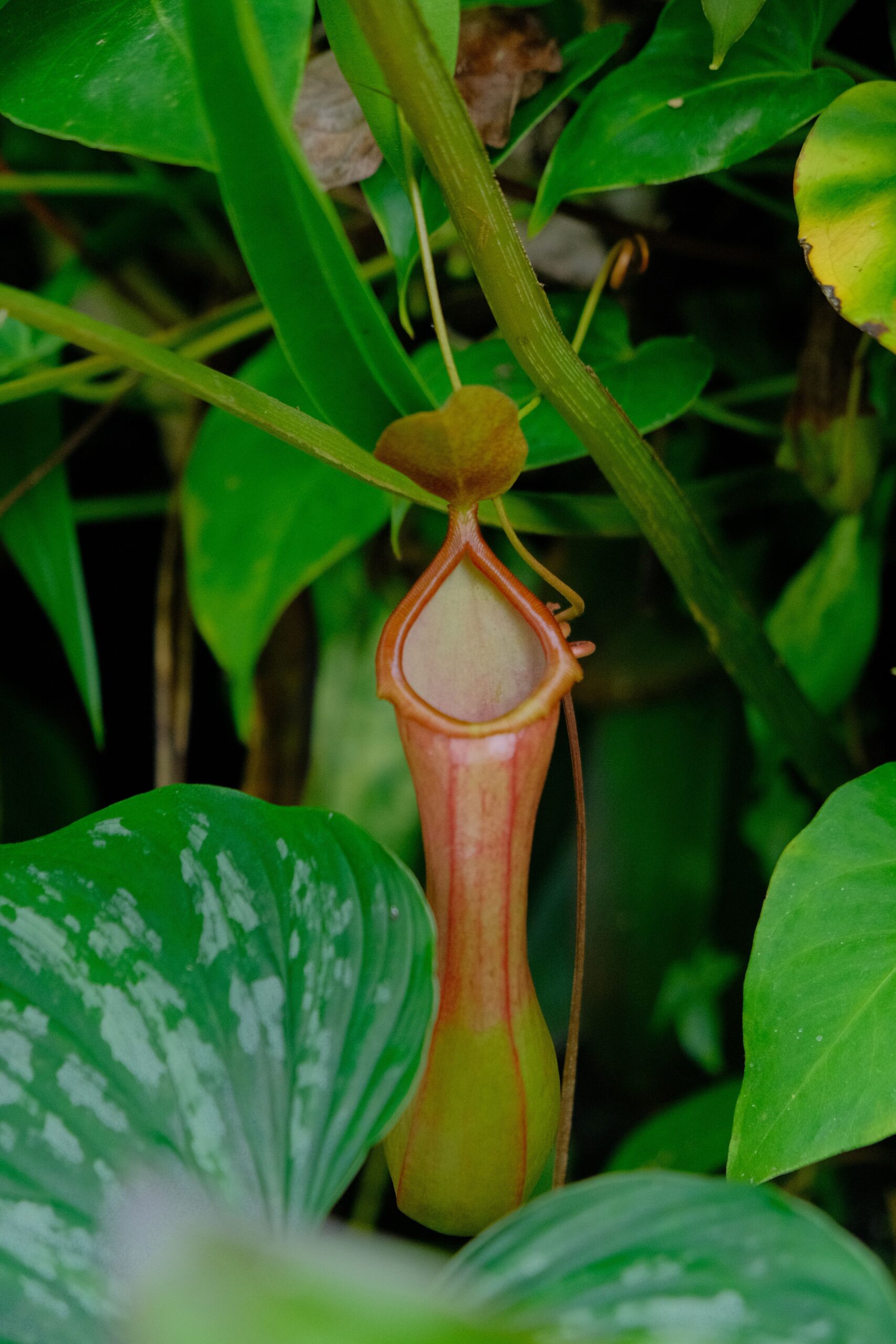
The rim of a pitcher, called the peristome, can become extremely slippery, particularly when wet. When an insect loses its grip, it falls into the pitcher. Some species also have waxy inner walls and downward-pointing hairs that prevent insects from climbing back out.
3. Digesting insects
Once trapped, insects encounter digestive fluid inside the pitcher. Depending on the species, the plant produces digestive enzymes that break down proteins and other organic substances. Microorganisms may also help with digestion.
4. Absorbing nutrients
After digestion, specialized cells inside the pitcher absorb the released nutrients. These substances are transported into the plant and support its normal growth and development.
Did you know? Pitcher plants do not close their traps like Venus flytraps. Their pitchers generally use a passive trapping mechanism, relying on slippery surfaces, nectar and gravity to capture insects.
How Do Pitcher Plants Get Nutrition?
Nutrition is one of the most interesting aspects of pitcher plants. Most grow naturally in environments where the soil contains limited amounts of essential minerals. Their carnivorous adaptations help them obtain additional nutrients that ordinary plants generally absorb through their roots.
However, insects are not their primary energy source. Pitcher plants use sunlight, water and carbon dioxide to produce sugars through photosynthesis. Insects provide supplementary minerals, particularly nitrogen and phosphorus.
How pitcher plant nutrition works
Sunlight provides the energy for photosynthesis, while insects provide additional nutrients. The plant combines these two strategies to survive in nutrient-poor environments.
1. Nitrogen: Supporting healthy growth
Nitrogen is essential for producing proteins, enzymes and chlorophyll. Chlorophyll is the green pigment that allows plants to absorb sunlight for photosynthesis.
Insects contain nitrogen-rich compounds, which pitcher plants can obtain through digestion. This is especially useful in habitats where nitrogen is scarce in the soil.
2. Phosphorus: Supporting energy transfer
Phosphorus plays an important role in energy transfer, cell membranes, DNA and normal plant development. Pitcher plants can obtain phosphorus from captured prey, helping compensate for limited mineral availability in their natural habitats.
3. Potassium and other minerals
In addition to nitrogen and phosphorus, insects may supply potassium and other minerals in smaller amounts. These nutrients contribute to cellular functions, water regulation and healthy plant development.
4. Do pitcher plants get energy from insects?
No. This is a common misunderstanding. Pitcher plants are still photosynthetic plants. They use sunlight to produce sugars, which provide the energy and carbon compounds needed for growth.
Insects mainly supplement their mineral nutrition. Without sunlight, catching insects alone would not provide everything the plant needs to survive.
Do Pitcher Plants Need Fertilizer?
Pitcher plants have different nutritional requirements from ordinary houseplants. Because they naturally grow in nutrient-poor habitats, their roots are often sensitive to the high mineral concentrations found in standard fertilizers.
Most pitcher plants do not need regular fertilizer when they receive suitable light, appropriate water and occasional natural prey.
| Feeding method | Is it suitable? | Important details |
|---|---|---|
| Natural insects | Yes | Usually sufficient for plants that catch their own prey. |
| Regular garden fertilizer | No | Can damage sensitive roots because of excess nutrients and salts. |
| Fish food | Sometimes | Some experienced growers use tiny amounts of suitable fish food, but overfeeding can cause problems. |
| Specialist carnivorous plant fertilizer | Species-dependent | Some growers use very dilute formulations with suitable species. |
| Compost | Generally unsuitable | Usually contains too many nutrients for typical pitcher plant growing mixes. |
Important feeding tip: Never place large amounts of food inside a pitcher. Excess food can rot and create an unhealthy environment. Healthy outdoor plants can usually catch their own insects without assistance.
Different Types of Pitcher Plants
There are several groups of pitcher plants found around the world. Although they share similar insect-catching adaptations, their appearance, habitats and growing requirements can be very different.
1. Tropical Pitcher Plants (Nepenthes)
Nepenthes are among the most recognizable pitcher plants. They are native mainly to tropical regions of Southeast Asia, including Malaysia, Indonesia and the Philippines.
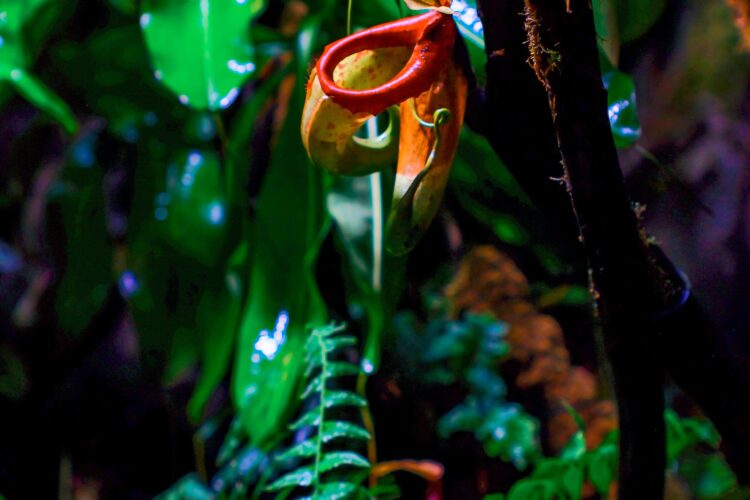
Many species grow as climbing vines, producing hanging pitchers at the ends of their leaves. Their traps can be green, red, purple or beautifully patterned.
Some Nepenthes grow as epiphytes on trees, while others grow directly in the ground. These differences mean that their growing requirements can vary considerably.
2. American Pitcher Plants (Sarracenia)
Sarracenia are native to North America, particularly wetland environments in the eastern United States and parts of Canada.
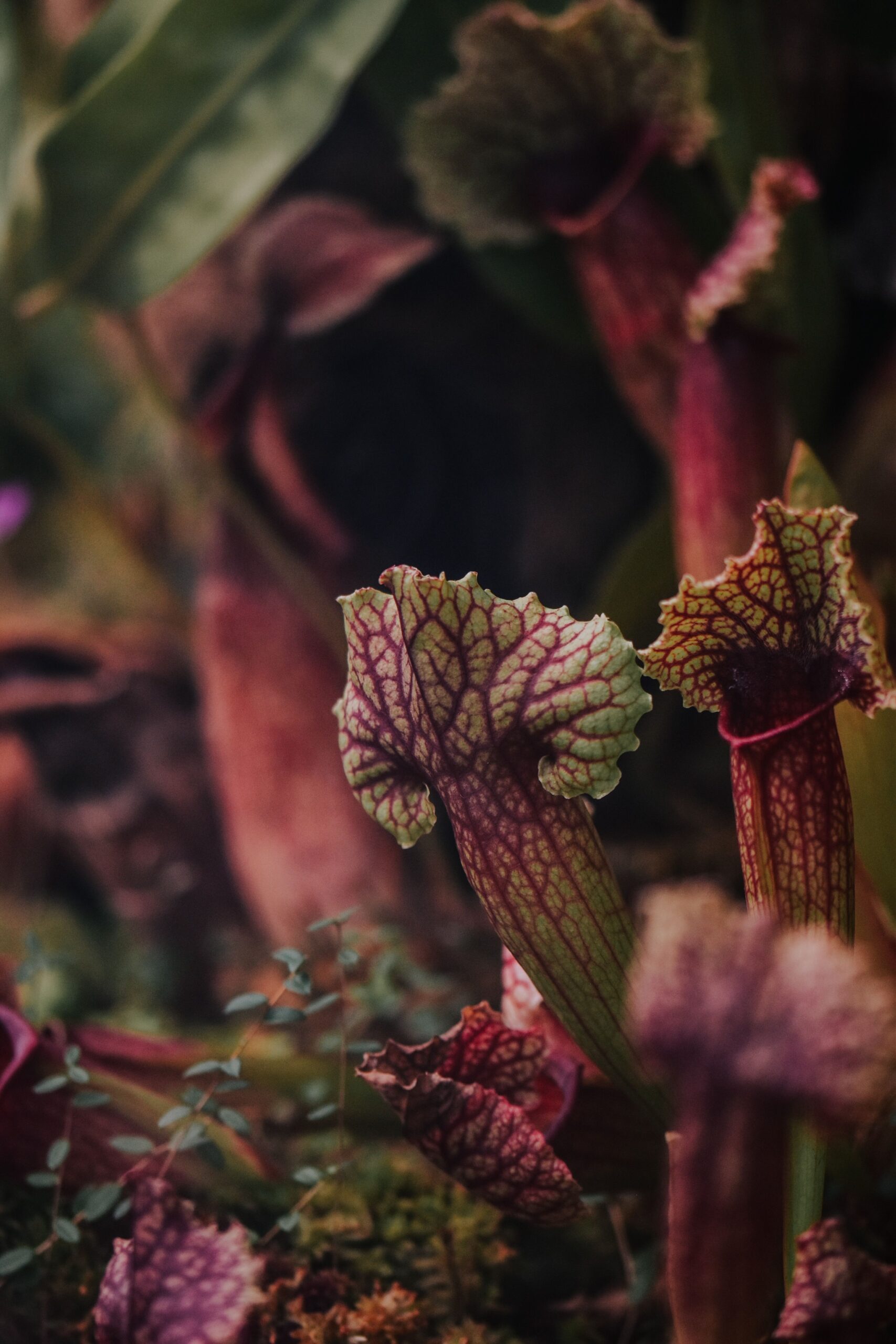
They produce upright, trumpet-shaped pitchers that attract insects through their colors and nectar. Once insects enter, slippery surfaces and downward-pointing hairs make escaping difficult.
Popular varieties include:
- Sarracenia flava: Yellow pitcher plant.
- Sarracenia purpurea: Purple pitcher plant.
- Sarracenia leucophylla: White-top pitcher plant.
- Sarracenia psittacina: Parrot pitcher plant.
3. Cobra Lily (Darlingtonia californica)
The cobra lily is a distinctive carnivorous plant native to northern California and Oregon. Its pitcher resembles the raised head of a cobra, giving the plant its unusual common name.
It has a specialized trapping structure with translucent windows that can confuse insects trying to escape. Unlike many other pitcher plants, it is also known for its preference for cool water around its roots.
4. Sun Pitchers (Heliamphora)
Heliamphora species are native to the mountainous regions of South America, especially the Guiana Highlands.
They produce elegant, upright pitchers that collect insects and other small organisms. Many species rely partly on microorganisms to break down captured prey.
5. Australian Pitcher Plant (Cephalotus follicularis)
Cephalotus follicularis is a small carnivorous plant native to southwestern Australia. It produces compact pitchers with distinctive lids and toothed-looking rims.
Unlike the climbing tropical Nepenthes, this species generally grows close to the ground and produces relatively small traps.
Where Do Pitcher Plants Grow in the Wild?
Pitcher plants grow in a variety of environments depending on their species. Many are adapted to habitats where the soil is wet, acidic and naturally low in nutrients.
American pitcher plants are commonly found in wetlands, bogs and other moist habitats. Tropical Nepenthes species occur in rainforests, mountainous areas and humid tropical forests.
Some tropical pitcher plants grow on trees as epiphytes, while others grow in soil. This is why different species require different levels of moisture, temperature and humidity.
The Evolution of Pitcher Plants
The evolution of pitcher plants is an interesting example of how unrelated plants can develop similar adaptations to survive in challenging environments.
Different groups evolved pitcher-shaped trapping leaves independently. This process is called convergent evolution. It occurs when different organisms develop similar characteristics because they experience comparable environmental pressures.
For pitcher plants, nutrient-poor environments created a challenge. Their ancestors developed modified leaves that could attract and capture insects, providing an additional source of nitrogen and phosphorus.
Although Nepenthes and Sarracenia look similar, they belong to different botanical families. Their pitcher-shaped traps are separate evolutionary adaptations rather than evidence that they share a recent pitcher-producing ancestor.
Do Pitcher Plants Produce Flowers?
Yes, pitcher plants produce flowers. Their unusual traps receive most of the attention, but their flowers are important for reproduction.
Different species produce flowers in different shapes and colors. Sarracenia flowers often grow on tall stalks, while Nepenthes produce clusters of smaller flowers.
Many pitcher plants have flowers positioned separately from their traps. This can help reduce the likelihood of trapping visiting pollinators.
Most Nepenthes species have separate male and female plants, so both are generally needed for successful seed production.
How Do Pitcher Plants Reproduce?
Pitcher plants can reproduce through seeds and, depending on the species, vegetative propagation.
Seed propagation
After pollination, flowers can develop into seed-producing structures. The seeds can be collected and grown under suitable humidity, temperature and lighting conditions. However, germination and early growth may take considerable time.
Division
Some Sarracenia species can be propagated by dividing their rhizomes. Each healthy division should have suitable roots and growing points so that it can establish itself.
Stem cuttings
Some Nepenthes species can be propagated through stem cuttings. Suitable cuttings are placed in an appropriate moist growing medium until new roots develop.
How to Grow Pitcher Plants at Home
Growing pitcher plants at home can be rewarding when their natural requirements are understood. However, they need different conditions from ordinary indoor houseplants.
1. Provide suitable lighting
Light requirements depend on the species. Sarracenia generally prefer plenty of direct sunlight, while many tropical Nepenthes grow best in bright, indirect light.
If you are growing pitcher plants indoors, a suitable grow light can help maintain healthy growth when natural sunlight is insufficient.
2. Choose the right growing medium
Pitcher plants need a low-nutrient growing medium. A common mix for many species includes unfertilized sphagnum peat and perlite or washed silica sand.
Tropical Nepenthes often prefer a more open, airy medium containing long-fiber sphagnum moss and perlite.
Avoid ordinary garden soil, compost and fertilizer-rich potting mixes.
3. Use suitable water
Water quality is extremely important. Rainwater, distilled water or suitable reverse-osmosis water is generally recommended because pitcher plants are sensitive to dissolved minerals.
Avoid regular mineral-rich tap water unless you have confirmed that its mineral content is suitable for your species.
4. Maintain appropriate humidity
Tropical Nepenthes generally appreciate warm, humid conditions, although the exact requirements vary between lowland and highland species.
Sarracenia usually perform better outdoors in strong sunlight with consistently moist growing conditions rather than in a warm, enclosed indoor environment.
5. Understand winter dormancy
Many temperate pitcher plants, including several Sarracenia species, need a winter dormancy period. Their growth slows, and older pitchers may turn brown or die back.
Do not assume a dormant plant is dying. Seasonal dormancy is a normal part of its life cycle.
Can You Grow Pitcher Plants Indoors?
Yes, certain pitcher plants can grow indoors when their light, humidity, temperature and watering requirements are met.
Tropical Nepenthes varieties are popular indoor choices because many can adapt to bright indoor spaces. Hanging baskets can also provide room for their climbing stems and dangling pitchers.
However, temperate Sarracenia generally perform better outdoors because they need strong sunlight and seasonal dormancy.
Which pitcher plant is best for indoors?
Many adaptable tropical Nepenthes varieties are suitable for indoor growing. Choose a species based on your available light, temperature and humidity rather than selecting a plant based only on its appearance.
Interesting Facts About Pitcher Plants
- Pitcher plants use modified leaves to trap insects and other small organisms.
- They obtain additional nutrients because many naturally grow in nutrient-poor environments.
- Some Nepenthes species produce hanging pitchers along long climbing vines.
- Giant tropical pitcher plants can develop remarkably large traps.
- Some pitcher plants have interesting relationships with frogs and other animals.
- Nepenthes lowii has a remarkable relationship with tree shrews, which feed on nectar and deposit nutrient-rich droppings into the pitchers.
- Pitcher plants produce their own energy through photosynthesis rather than depending on insects for energy.
- Different groups evolved their pitcher-shaped traps independently.
Do Frogs Live Inside Pitcher Plants?
Yes, some frogs use pitcher plants as shelter or breeding habitats. Certain small frog species live around or inside pitchers, particularly in tropical environments.
Some frogs use the water collected inside pitchers as a place for their eggs and tadpoles. Other animals may use pitchers as temporary shelter.
These relationships vary by species. Not every pitcher plant contains frogs, and these interactions are not universal across all carnivorous plants.
How Long Do Pitcher Plants Live?
Pitcher plants are generally long-lived perennial plants when grown under suitable conditions. Their lifespan depends on the species, environment and quality of care.
Individual pitchers do not last forever. Older traps eventually dry out and turn brown as the plant produces new leaves and pitchers.
A healthy plant can continue producing new traps over many growing seasons.
Frequently Asked Questions About Pitcher Plants
What do pitcher plants eat?
Pitcher plants commonly capture ants, flies, beetles and other small insects. Some larger species may also capture other small organisms.
Do pitcher plants need insects to survive?
Insects provide additional nutrients, especially nitrogen and phosphorus. However, pitcher plants produce energy through photosynthesis and can survive without regularly catching insects.
Can pitcher plants eat frogs?
Some large pitcher plants occasionally capture small frogs and other small animals, but insects and other invertebrates are much more typical prey.
Can I feed my pitcher plant fish food?
Some growers use very small quantities of suitable fish food for certain species. However, excessive feeding can cause problems inside the pitcher. Natural insect feeding is generally sufficient for healthy plants.
Should I put water inside pitcher plants?
Some Nepenthes pitchers naturally contain digestive fluid. Avoid disturbing or unnecessarily filling them. Follow the requirements of your particular species.
Do pitcher plants need sunlight?
Yes. They need suitable light for photosynthesis. Sarracenia generally prefer strong direct sunlight, while many Nepenthes varieties prefer bright indirect light.
Are pitcher plants difficult to grow?
They can be manageable when their specific growing requirements are understood. Choosing a suitable species and providing mineral-free water makes cultivation easier.
Do pitcher plants die in winter?
Some temperate varieties enter dormancy during winter. Their growth slows and older pitchers may turn brown. Tropical species generally have different temperature and seasonal requirements.
How big do pitcher plants get?
Size varies significantly between species. Some produce compact pitchers only a few centimetres long, while giant tropical Nepenthes species can develop pitchers measuring more than 30 centimetres.
How often should I feed an indoor pitcher plant?
Indoor pitcher plants do not usually need a strict feeding schedule. If they occasionally catch small insects naturally, additional feeding may not be necessary.
Are pitcher plants poisonous?
Pitcher plants are not generally considered poisonous to people, but they are not edible plants. Avoid consuming plant parts or pitcher liquid.
Final Thoughts
Pitcher plants are remarkable examples of how plants adapt to challenging environments. Their unusual pitcher-shaped leaves allow them to capture insects and obtain additional nutrients that may be difficult to find in their natural habitats.
From tropical Nepenthes to North American Sarracenia, these carnivorous plants offer an incredible variety of shapes, colors and growing habits. Understanding their nutritional needs, natural habitats and individual care requirements is the key to growing them successfully.
Whether you are interested in their fascinating evolution or want to add a carnivorous plant to your collection, pitcher plants are a wonderful reminder of how diverse the plant world can be.
Explore More Plant Care Guides
Discover practical growing tips, watering advice and helpful information about unusual plants with HappyPlant.
Sources and Further Reading
- Royal Botanic Gardens, Kew – Carnivorous Plants
- Royal Horticultural Society – Carnivorous Plants
- U.S. Fish and Wildlife Service – Plant and Wildlife Conservation
- International Carnivorous Plant Society
This article is for general educational purposes. Pitcher plant care requirements vary by species, so always research the specific variety before growing it.
0 Comments