
Introduction: Can Plants Really Make You Happy?
You’ve felt it — walking into a room full of greenery and instantly exhaling. Or nurturing a cutting for weeks until roots appear and feeling a surge of genuine pride. There’s something about plants that quietly but powerfully lifts the human spirit.
But is it real? Can plants actually make you happy, or is it all just aesthetic preference dressed up in pseudoscience?
The answer, backed by a growing body of research, is a resounding yes. Plants make people happy — and in this article, we explore exactly why, how to maximise that effect, whether your plants can feel it too, and everything from the best grow lights to pop culture’s most beloved plant moments.
Do Plants Make People Happy? What Science Says
The question do plants make people happy has been studied seriously by psychologists, environmental scientists, and horticultural therapists for decades.
Here’s what the research shows:
Biophilia: Humans Are Wired for Nature
The concept of biophilia, first popularised by biologist E.O. Wilson, proposes that humans have an innate, evolutionary need to connect with other living things. We spent 99% of our evolutionary history surrounded by nature — so it makes sense that being near plants feels good at a biological level.
Measurable Mood Benefits
- A 2015 study published in the Journal of Physiological Anthropology found that interacting with indoor plants reduces psychological and physiological stress — specifically lowering cortisol (the stress hormone) and blood pressure.
- Research from the University of Exeter found that workers in offices with plants reported a 15% higher wellbeing score and were 6% more productive.
- A 2022 study in Urban Forestry & Urban Greening confirmed that do plants make you happier isn’t just anecdotal — people who actively care for plants consistently score higher on life satisfaction indices.
Gardening as Therapy
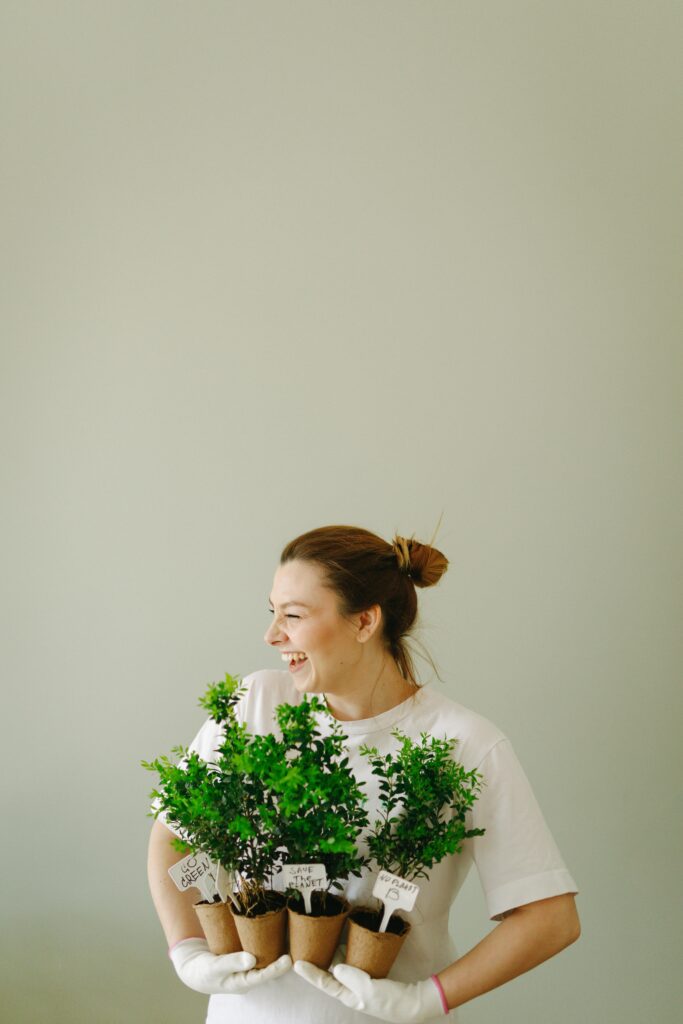
Horticultural therapy — the practice of using plant-based activities to improve mental and physical health — is now used in hospitals, rehabilitation centres, and care homes worldwide. The rhythmic, purposeful act of watering, potting, and pruning has measurable anti-anxiety effects comparable to mindfulness meditation.
So yes: do plants make you happy? Science is clear. They do.
Can Plants Be Happy?
Now for the flip side. If plants make us happy — can plants be happy themselves?
This is where science gets genuinely fascinating. Plants don’t have brains, nervous systems, or emotions as we understand them. But they are far from passive:
- Plants communicate through chemical signals, releasing compounds to warn neighbouring plants of insect attacks (source: Smithsonian Magazine)
- They respond to stimuli — turning toward light, closing leaves when touched, even “screaming” via ultrasonic vibrations when stressed (a 2023 study from Tel Aviv University)
- Some research suggests plants recognise their kin and compete less aggressively with related plants than strangers
So can plants be happy in the way humans are? No. But they can be thriving — and a thriving plant is the closest thing to a happy one. Lush leaves, active growth, stable roots, and the right environment are the plant equivalent of wellbeing.
Signs your plant is “happy”:
- Upright, firm stems
- Rich green (or true-to-variety) leaf colour
- Regular new growth
- No pests, no drooping, no yellowing
Do Fake Plants Make You Happy?
It’s a fair question — especially for people in dark rooms, rental properties, or those who’ve killed every living plant they’ve owned: do fake plants make you happy?
The honest answer: somewhat, but not as much as real ones.
Research from University of Hyogo in Japan found that simply viewing realistic artificial plants reduced stress, but the effect was smaller than with real plants. The act of caring for a living thing — watering, watching growth — appears to be central to the mood benefit. A fake plant sits there; a real plant responds.
That said, do fake plants make you happy in a purely aesthetic sense? Absolutely. If a well-styled faux fiddle leaf fig makes your living room feel more alive and you can’t keep real plants, there’s no shame in it. Some happiness is better than none.
For the fullest mental health benefit, however, real living plants are worth the extra effort.
Can Happy Lights Help Plants Grow?
One of the most common questions from indoor plant lovers: can happy lights help plants grow?
First, a clarification on terminology. “Happy lights” or “happy lamps” typically refer to SAD lamps — bright light therapy devices designed to simulate sunlight for humans suffering from Seasonal Affective Disorder (SAD). They emit broad-spectrum white light at very high lux levels (typically 10,000 lux).
So: do happy lights work for plants?
The short answer is: partially, and it depends.
Can I Use a Happy Light for Plants?
Can I use a happy light for plants — or more precisely, can you use a happy light for plants — is a question with a nuanced answer:
| Factor | Happy Light | Dedicated Grow Light |
|---|---|---|
| Light spectrum | Broad white light | Full spectrum incl. red & blue |
| Intensity (lux) | High (10,000 lux) | Variable, adjustable |
| Red/blue wavelengths | Limited | Optimised for photosynthesis |
| Cost | £30–£80 | £20–£150+ |
| Best for | Low-light supplementation | Serious indoor growing |
| Verdict | Works for some plants | More effective overall |
Do happy lights help plants that just need a little more light — like a dracaena on a dim shelf or a pothos in a windowless office? Yes, somewhat. The broad white spectrum does include some photosynthetically active radiation (PAR), and the high intensity can compensate for low natural light.
Does a happy light help plants that need intense light to thrive — like tomatoes, cacti, or herbs? Less effectively. These plants need more red and blue spectrum wavelengths than most happy lamps provide.
Does happy light work for plants year-round? Better in winter than summer. In summer, most indoor plants should get enough natural light. In winter — or in genuinely dark rooms — a happy light is better than nothing.
The Best Alternative: Dedicated Plant Grow Lights
For best results, invest in a proper grow light designed for plants. Look for:
- Full spectrum (380–780nm wavelength range)
- Adjustable intensity
- A timer function
- Mars Hydro and Spider Farmer are well-reviewed brands
These are far more effective than asking can you use a happy light for plants — though for casual, low-demand houseplants, a happy lamp in a pinch is a perfectly reasonable solution.
Dracaena Fragrans: The Original Happy Plant
No article about happy plants is complete without covering the star of the show — the Dracaena fragrans happy plant, the species most commonly known simply as the “happy plant.”
What Is Dracaena Fragrans?
Dracaena fragrans is a tropical flowering plant native to tropical Africa. In the wild, it grows into a small tree up to 15 metres tall. As a houseplant, it typically reaches 1–2 metres and is beloved for its:
- Bold, arching green leaves (sometimes striped yellow in the ‘Massangeana’ variety)
- Tolerance of low light and neglect
- Air-purifying properties (NASA Clean Air Study)
- Symbolic meaning — in Chinese culture, the dracaena fragrans happy plant represents good luck, positive energy, and prosperity
Quick Care Reference
| Care Aspect | Requirement |
|---|---|
| Light | Bright indirect to low light |
| Water | Every 1–2 weeks (when top soil is dry) |
| Humidity | Average household |
| Temperature | 16–24°C |
| Feeding | Monthly in spring/summer |
| Toxicity | Toxic to cats and dogs |
Find Dracaena fragrans at Bunnings, IKEA Plant Shop, and specialist nurseries like Happy Plants Nursery.
Does the Happy Bean Plant Flower?
The happy bean plant (Peperomia ferreyrae) is a compact succulent-like plant with bright green, bean-shaped leaves. One of the most common questions about it: does happy bean plant flower?
Yes — but don’t get too excited. Like most peperomias, the happy bean plant does produce flowers, but they are tiny, pale green or cream-coloured spikes called catkin-like inflorescences. They’re not showy by any means and are often trimmed off to redirect the plant’s energy back into foliage.
If does happy bean plant flower is your concern, the real draw of this plant is its quirky, sculptural foliage — not its blooms.
Happy bean plant care at a glance:
- Light: Bright indirect light; tolerates some morning sun
- Water: Let soil dry completely between waterings
- Soil: Well-draining cacti/succulent mix
- Feed: Diluted Happy Happy Plant Food monthly in summer
- Flowers: Yes — small, inconspicuous spikes; often removed
Cartoon Happy Plant: Plants in Pop Culture
Plants have always found their way into our stories, cartoons, and films — often as symbols of life, growth, and joy.
Famous Cartoon Happy Plants
- Little Shop of Horrors — Audrey II is the most iconic plant in film history; a monstrous but strangely lovable cartoon happy plant villain
- The Lorax (Dr. Seuss) — the Truffula Trees are perhaps the most emotionally resonant plants in children’s literature
- Wall-E — a single green seedling becomes the symbol of hope for all of humanity
- Pikmin (Nintendo) — plant-like creatures that are genuinely the most cartoon happy plant energy in gaming
- Brave (Pixar) — the enchanted will-o’-wisps guiding the protagonist through forest and flora
Each of these uses plant imagery to represent growth, resilience, or the future — which brings us to one very specific pop culture moment.
Dinosaurs Happy Plant Episode: The One That Changed TV
If you grew up in the early 1990s, you may remember the American sitcom Dinosaurs — a Jim Henson production that used dinosaur puppets to satirise suburban family life and, frequently, serious social issues.
The Dinosaurs Happy Plant Episode
The Dinosaurs happy plant episode is formally titled “Nuts to War” (Season 2, Episodes 19 & 20), though the most frequently referenced “happy plant” episode among fans is actually “A New Leaf” (Season 3, Episode 8) — widely considered one of the most powerful episodes of the entire series.
In the Dinosaurs happy plant episode “A New Leaf”:
- Earl Sinclair discovers a plant that, when its leaves are eaten, produces intense feelings of euphoria and happiness
- The plant rapidly becomes addictive, spreading through the community
- The episode is a clear, unflinching allegory for drug addiction and legalisation debates
- It ends without a tidy resolution — one of the few children’s shows of its era to portray addiction with genuine gravity
The dinosaurs happy plant storyline is frequently cited by critics as among the most daring writing in early-90s family television. You can find clips and discussion on YouTube and fan communities on Reddit.
The dinosaurs happy plant episode is worth watching as an adult — it hits very differently than it did as a child.
The Future Happiness Plant: Where Science Is Heading
The idea of a future happiness plant sits at the intersection of biotechnology, mental health research, and environmental design — and it’s closer to reality than you might think.
Biophilic Design and the Built Environment
Biophilic design is now a mainstream architectural principle — integrating living walls, indoor forests, rooftop gardens, and plant-filled corridors into hospitals, schools, offices, and homes to improve wellbeing at scale. The Eden Project in Cornwall is the most ambitious physical embodiment of this idea.
Plants That Respond to Human Emotion
Research at MIT’s Media Lab has explored biosensing plants — plants fitted with sensors that respond to or even reflect human emotional states. While still experimental, the concept of a future happiness plant that genuinely interacts with your mood is being seriously researched.
Genetically Modified Mood-Enhancing Plants
Perhaps most intriguingly, a 2023 paper in Nature Biotechnology explored the modification of plants to produce elevated levels of compounds like linalool (a lavender-associated calming terpene) and other plant-derived mood modulators. A plant designed specifically to improve its owner’s mental health — the true future happiness plant — may not be science fiction for much longer.
CBD and Plant-Based Mental Wellness
The explosion of interest in plant-based wellness — from CBD to adaptogenic herbs to aromatherapy — reflects a wider cultural turn toward plants as mental health tools. The line between “happy plant” as a houseplant and “happy plant” as a therapeutic tool is blurring.
The Full Picture: Plants and Human Happiness
Let’s bring it all together. Here’s what we know for certain:
| Question | Answer |
|---|---|
| Do plants make you happy? | Yes — backed by science |
| Can plants be happy? | They can thrive; not emotionally happy |
| Do fake plants make you happy? | Partially — less than real ones |
| Can happy lights help plants grow? | Yes, for low-light plants; grow lights are better |
| Can you use a happy light for plants? | Yes, as a supplement to natural light |
| Does happy bean plant flower? | Yes — small, inconspicuous blooms |
| What is the dinosaurs happy plant episode? | “A New Leaf” — a powerful addiction allegory |
| What is the future happiness plant? | Biophilic design, biosensing, and GM plants |
Final Thoughts: Planting Happiness, Growing Joy
From the Dracaena fragrans happy plant sitting in a sunbeam to the iconic dinosaurs happy plant episode that made a generation think harder than expected, from the growing science of biophilic wellbeing to the frontier of the future happiness plant — plants and human happiness are deeply, irrevocably intertwined.
Whether you’re adding your first succulent to a windowsill, investing in a grow light for a dark corner, or just looking up cartoon happy plant GIFs on a Tuesday afternoon — you’re participating in something ancient and real.
Plants make people happy. The evidence is in. Now go water something.
Continue reading:
- The Ultimate Happy Plant Care Guide — Dracaena fragrans from beginner to expert
- Happy Plant Products, Gifts & Brands — LEGO Happy Plants, Happy Happy Plant Food & more
- Best Grow Lights for Indoor Plants in 2025 — reviewed and ranked


0 Comments